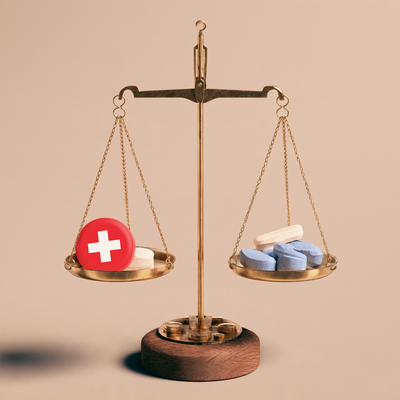
My career as a pharmacist has crossed three healthcare systems: Romania, Moldova and Switzerland. Each move required me to learn a new set of rules, institutions and expectations. The common thread is that regulation is not an obstacle to practice; it is the shared language that makes safe practice possible.
This article describes that journey and what it taught me about working in a regulated environment.
Foundations in Romania
I studied pharmacy at Ovidius University in Constanța from 2009 to 2014, completing a 300-ECTS degree and graduating 57th out of 204 students. The programme combined natural sciences, biomedical sciences and pharmaceutical practice, including pharmacology, toxicology, clinical pharmacy, immunology and drug analysis.
As a member of the Romanian College of Pharmacists, I also completed continuing education in pharmaceutical legislation and good practice. That early focus on legislation shaped how I approach every new system: I start by understanding the rules that protect patients.
Hospital practice in Moldova and Romania
From 2014 to 2017, I worked as a hospital pharmacist in the surgery unit of the National Hospital in Moldova. I managed medication supply for post-operative patients and coordinated medication planning with surgical teams, keeping patient and prescription records up to date.
I then worked as a pharmacist and supervisor in a hospital setting with Catena in Romania. There I analysed dosages and therapeutic appropriateness and coordinated with clinical teams on prescription safety.
Hospital work teaches a particular kind of discipline. Errors can have immediate consequences, documentation must be complete, and safety depends on several professions communicating clearly.
Coming to Switzerland
Moving to Switzerland meant two parallel paths: further education and professional recognition.
In 2021 I began the MSc in Drug Sciences at the University of Basel, which I completed in 2026. It deepened my knowledge of toxicology, immunosafety, regulatory science and drug development.
At the same time, I worked through recognition of my pharmacy qualification. In Switzerland, foreign diplomas in the medical professions are assessed by MEBEKO, the Federal Commission for Medical Professions (Medical Professions Act [MedBG], 2006). Qualifications from EU countries can be recognised under the agreement on the free movement of persons between Switzerland and the EU (Agreement on the Free Movement of Persons [AFMP], 1999; Directive 2005/36/EC, 2005). I received MEBEKO recognition at federal level in February 2024.
What recognition actually involves
For anyone considering a similar path, the process has several layers:
- Diploma recognition by MEBEKO, confirming that the foreign qualification is equivalent to the Swiss federal diploma (MedBG, 2006).
- Registration in the federal register of medical professions (MedBG, 2006).
- Language requirements for the profession, since pharmacists must be able to communicate safely with patients (MedBG, 2006).
- A cantonal licence to practise independently, because the cantons regulate professional practice (MedBG, 2006).
The process taught me how the Swiss system distributes responsibility between federal and cantonal levels, a structure that also applies to medicines regulation.
Swiss practice
I have worked in Swiss community pharmacy since 2023, first at Amavita in Bülach and now at Coop Vitality in Feuerthalen. My responsibilities include patient counselling on medication safety and interactions, identifying and escalating suspected adverse reactions, and ensuring compliance in prescription management, storage and pharmacy operations.
Working across systems has made me attentive to detail in a specific way. I never assume that a rule I learned elsewhere applies here. I check.
Five lessons from three systems
- Principles travel; procedures don't. Patient safety, traceability and accountability are universal (World Health Organization [WHO], 2017). The forms, timelines and authorities differ.
- Documentation is the bridge. Clear records allow colleagues, inspectors and authorities to understand decisions, whatever the system.
- Federal and local layers both matter. In Switzerland, as in many countries, national law and regional oversight work together.
- Adaptability is a competence. Learning a new regulatory system quickly is a skill that improves with practice.
- Languages are a safety tool. Working in Romanian, English and German, with growing French, means I can communicate with more patients and colleagues and read regulatory texts in their original language.
Why this matters to employers
Pharmaceutical companies in Switzerland operate across borders every day. Their teams align Swiss requirements with EU and global standards, coordinate with colleagues in several countries and work in multiple languages.
I bring direct experience of adapting to new regulatory systems, hospital and community practice in three countries, and a Swiss MSc focused on drug safety. That combination prepares me for roles where regulation, quality and safety meet.
Key takeaways
- Regulation is a shared language for safe practice, not a barrier to it.
- Swiss recognition of foreign pharmacy qualifications involves federal and cantonal steps.
- Experience across systems builds adaptability, attention to detail and strong documentation habits.
References
Agreement on the Free Movement of Persons [AFMP] between the Swiss Confederation and the European Community and its Member States of 21 June 1999, SR 0.142.112.681. https://www.fedlex.admin.ch
Directive 2005/36/EC of the European Parliament and of the Council of 7 September 2005 on the recognition of professional qualifications. (2005). Official Journal of the European Union, L 255, 22–142.
Medical Professions Act [MedBG] of 23 June 2006, SR 811.11 (Switzerland). https://www.fedlex.admin.ch
World Health Organization. (2017). Medication without harm: WHO global patient safety challenge. World Health Organization.
Member discussion